
New Neuro-Oncologist Strengthens UCSF’s International Collaborations
Leveraging his position within large clinical trial consortiums, Martin van den Bent, MD, PhD is helping expand treatment options for patients.
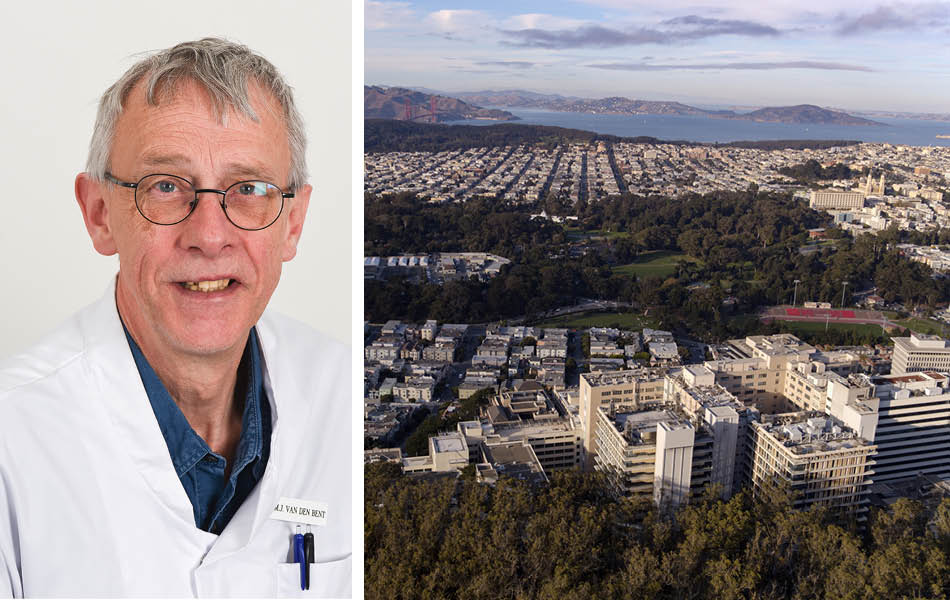
Martin J. van den Bent, MD, PhD, is a neuro-oncologist based in Rotterdam who is internationally recognized for his expertise in the field. He has been the principal investigator of many international multicenter phase 2 and 3 trials on both high- and low-grade gliomas that contributed to the standard of care for patients with these brain tumors. From 2003 to 2009, he held the position of chair of the European Organisation for Research and Treatment of Cancer (EORTC) Brain Tumor Group, and between 2018 and 2020, he served as president of the European Association of Neuro-Oncology. He currently holds positions as the head of the Protocol Review Committee of the EORTC and a professor of neuro-oncology at Erasmus University Rotterdam.
In his new role as an adjunct professor at UCSF, van den Bent teaches and mentors neuro-oncology faculty and fellows as well as the neurosurgery residents. He also serves on the External Advisory Board of the Brain Tumor (Specialized Program of Research Excellence) SPORE grant and helps increase UCSF’s participation in multicenter, international clinical trials.
Reinforcing longstanding connections
I've been working for many years with Dr. Susan Chang in the Response Assessment in Neuro-Oncology (RANO) Group. I’ve known Dr. Mitch Berger for a long period of time as an outstanding physician and a neurosurgeon who made a difference to our field. I know UCSF as a top-notch institution when it comes to brain tumor research. And I’m coming from an institution, where we did a lot of pivotal European studies on the improvement of the treatment of brain tumors.
I would like to set up more collaborations between our institutions. This is an opportunity to try and get more mileage out of the work that we’re doing.
The benefits of studying larger patient cohorts
We have a long way to go to understand which patients have the most benefit from which treatments. Without prospective trials, it becomes more complicated to figure out the predictive factors at stake when it comes to treatment benefits. We often need to use a part of the dataset to develop a model and the rest of the dataset to validate the model, so you really need really large datasets to make meaningful conclusions.
It's also clear that for some of the questions that we are studying, you need to collaborate to make sure what you are finding is not just true at your institution but across institutions.
Now, one of the neurosurgeons in my hospital Dr. Jasper Gerritsen is working with the neurosurgeons at UCSF and has started a large consortium, the PIONEER Consortium. There’s a similar effort within RANO, the RANO resect group, where Dr. Philipp Karschnia and Dr. Joerg-Christian Tonn are collaborating with many institutions but with a prominent role for UCSF.
Defining the right trial endpoints
When it comes to glioblastoma, what you're interested in is survival because most of these patients, unfortunately, die within one or two years after their first diagnosis.
But when it comes to IDH-mutated glioma, the quality of survival, especially if there are side effects associated with the treatment, also becomes very important. These patients can live for 10 to 20 years — or even longer.
That requires completely different trial methodology, and that's when assessing cognition and the patient-reported outcomes become much more important. And UCSF has an excellent footprint in looking at quality of survival.
Designing better clinical trials
If you don’t have a randomized trial, the only way you can collect the evidence in patients with a more favorable outcome is if you are able to follow well-defined cohorts of patients for a very, very long time. Otherwise, we will only assess short-term effects of treatment, and we won’t know what the results mean in the long run for these patients.
We also have learned over the past years it’s not just about doing randomized trials with a lot of patients. We have to be smarter at the earlier stages of the clinical trials before starting new large trials, rather than doing many trials in which just another drug is being added to whatever regimen.
What I like about EORTC, and what I like about some of the larger American trial efforts is that there’s really a philosophy behind it in which one step will lead to another.
The main challenge in both the U.S. and in Europe is to find interesting new trials to develop. Many trials are just smaller efforts of which the results just end up in journals, and that's it. The pivotal trials — in which you try to steer the guidelines or have novel treatments that you try to bring to the clinical arena because they improve outcome — those are the trials that are important.