

Physician-Scientist Maya Graham Joins the Neuro-Oncology Team
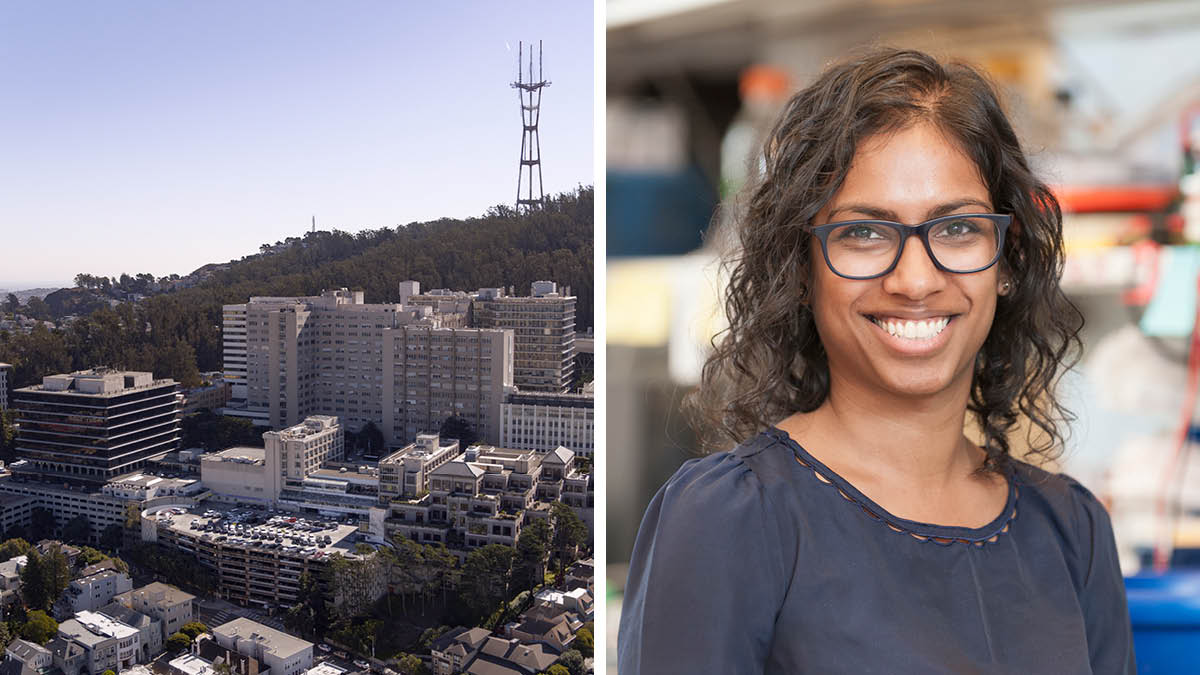
Graham’s focus at the intersection between genomics and stem cell biology builds on UCSF’s expertise in glioma research
Maya Graham, MD, PhD, earned her medical degree and her doctorate in neuroscience from Northwestern University. She then completed her residency in neurology at Mass General Brigham. She began her career caring for adult patients with brain tumors at Memorial Sloan Kettering Cancer Center after finishing a fellowship in neuro-oncology there. At MSK, she also worked as a postdoctoral researcher studying the epigenetics (changes in how DNA is organized and expressed) driving tumor formation in diffuse midline glioma. We spoke to Graham about her clinical practice and launching her own research lab.
Choosing neuro-oncology
I feel like a lot of MD-PhDs know that they want to be a doctor and then learn later that they're interested in research and decide to pursue the PhD. I did it the other way around. Both my parents have PhDs, so I always knew I wanted to do research. When I was getting my first research opportunities in high school and in college, I really became drawn to neuro-oncology from a research perspective.
At a cellular level, there are processes happening in the brain that then work their way up to the network or system level to define who we are. Then, in cancer, you have this parallel process caused by normal brain development going awry. And so, I found the intersection between those two fields to be really fascinating.
In the clinic, neuro-oncology is a really nice blend of building both a specialized practice as well as a longitudinal relationship with the patient. I get to be their primary physician and go-to for other health-related concerns, but in a very focused area of disease.
Modeling brain tumors in the lab
A lot of work trying to understand exactly where brain tumors come from starts with how well we can model these tumors in the lab. For a long time, the focus had been on mouse models. But we've also learned that there are a lot of cells that exist in a human brain that just don't have a matching cell type in a mouse.
I'm interested in building complementary models using stem cell-based approaches. I'm using cerebral organoids, which are basically 3D models of human brain development that start with a stem cell that you coach through certain culture conditions to grow into the different cell types that we find in early human brains. A lot of really beautiful work — much of which was done here at UCSF — has mapped out what all those different brain cell types are.
My work focuses on introducing mutations that we find in gliomas into organoids to see how those mutations in different types of cells can cause tumors. What happens when a cell expresses those mutations, especially mutations with known epigenetic consequences, really depends on the type of cell.
Similarities between tumor initiation and recurrence
We know that there are lots of different cell types in these gliomas, and they're not fixed. So, a cell with identity A can switch to have identity B or identity C. This feature, known as plasticity, makes treating the tumors like whack-a-mole. And a lot of the time, the mutations in that cell aren't changing, but the genes that it's expressing are changing. That’s usually a red flag that epigenetics is involved. How the DNA is organized — or its 3D structure — also influences dynamic changes within a cell.
New techniques where you can look at both what's happening to the epigenetics and the gene expression in the same cell at the same time are just coming out now. These tools will be really important in answering why mutations in adult-type gliomas may not be the whole story.
How basic science fuels clinical insights
One of the things that's been interesting coming out of our better understanding of mutations in cancer has been the concept of driver mutations in what are called basket clinical trials, which focus on the kind of mutations present in a tumor rather than the tumor type. The success of this approach in tumors with BRAF mutations, including gliomas, shows that the concept of a tumor-agnostic treatment, when we really understand the biology driving the cancer, is going to become really powerful.
I’m hopeful that some of these driving epigenetic principles are also common across different types of tumors. Then, we could bin tumors into their different epigenetic categories and target them that way.
The best part about being at UCSF
UCSF is a research institution that takes collaboration seriously. There are a lot of really innovative, high-powered scientists doing really incredible work who are really excited to work with each other, to work with new investigators, and to see where there might be interesting research questions to answer at the intersection of two different people’s bodies of work. And increasingly, we're understanding that a single perspective is not going to be enough for us to be able to figure out these tumors and design better treatments.